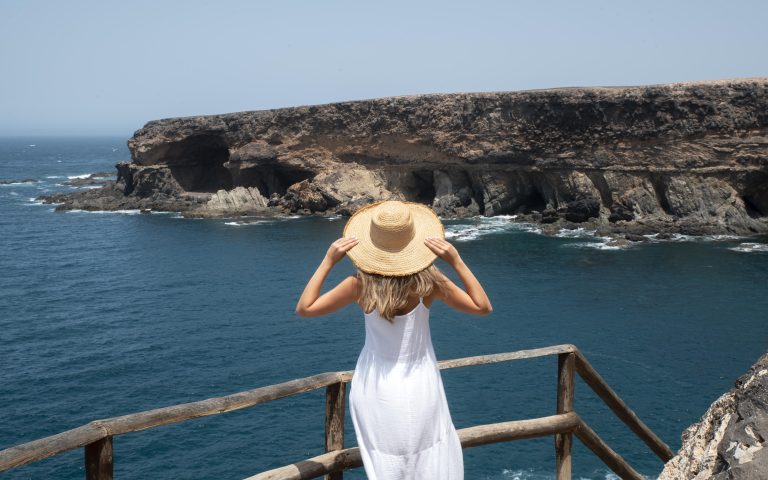
If you’ve ever looked at Tenerife from the air, you’ve already seen its secret: the whole island is a volcano. Rising out of the Atlantic, crowned by Mount Teide’s snow-tipped peak, Tenerife is both a holiday paradise and one of the most fascinating geological regions on Earth.
Visitors often ask, “Is Tenerife a volcano?” or “Is the volcano still active?” The short answer: yes, but not in a way that should worry you. Here’s what really lies beneath the island’s sunny beaches.
Table of Contents
A Volcano Born in the Atlantic
Tenerife sits on the Canary hotspot, a weak point in the Earth’s crust where magma slowly pushes upward. Millions of years ago, three smaller islands: Anaga, Teno and Adeje, merged through repeated eruptions to form the Tenerife we know today.
Mount Teide, the most famous cone, appeared later. It’s now 3,718 metres high, making it Spain’s tallest peak and the third-highest volcano in the world measured from the sea floor.
This volcanic heritage explains Tenerife’s dramatic contrasts, black-sand beaches, honey-coloured cliffs, and entire valleys carved by ancient lava flows. The island’s centrepiece, Teide National Park, is a UNESCO World Heritage Site where you can literally walk through millions of years of geological history.
For a detailed guide to visiting, see Teide National Park.
Is Tenerife Still Active?
Yes, Tenerife is considered dormant, not extinct. The island’s last eruption occurred in 1909, when the Chinyero vent opened on the northwest flank of Teide. Lava flowed for about ten days, damaging farmland but sparing villages.
Since then, seismic instruments have detected minor tremors, nothing unusual for volcanic islands. According to the Instituto Geográfico Nacional (IGN), Tenerife shows “low-level volcanic activity,” meaning magma still exists far below but is not moving toward the surface.
So when people ask, “When is the Tenerife volcano due to erupt?” scientists answer:
There is no sign of an imminent eruption.
The island is continuously monitored by GPS, thermal cameras, and satellite radar. If any significant change occurred, residents and visitors would have ample warning through Spain’s national alert system.
Inside the Crater: Visiting Teide Safely
Exploring Teide feels like stepping onto another planet. The upper crater, Las Cañadas del Teide, stretches 17 kilometres across, an enormous caldera formed by a prehistoric collapse. Within it rise dozens of smaller cones, solidified lava rivers, and ash plains that shift colour from red to gold as the sun moves.
The Teide Cable Car carries visitors to 3,555 metres, where air becomes thin and views stretch to La Gomera, Gran Canaria and La Palma. Those who climb the final 160 metres to the summit (permit required) can smell faint sulphur fumes, the mountain’s quiet reminder that it’s only sleeping.
Stargazing here is unforgettable; the clear air and altitude make it one of the best astronomical spots on Earth.
Other Volcanic Landscapes Worth Seeing
Teide is only part of Tenerife’s fiery story. Around the island, you’ll find traces of eruptions in unexpected places:
- Malpaís de Güímar: a vast lava field on the east coast, dotted with cactus and salt-resistant shrubs. Ideal for easy walks near the sea.
- Chinyero Nature Reserve: site of the 1909 eruption, where dark lava tongues still cover the pine forest floor.
- Garachico: a coastal town rebuilt after being destroyed by lava in 1706. Today, its natural rock pools are among the island’s best swimming spots.
- Los Gigantes cliffs: ancient volcanic rock compressed over millennia, now rising sheer from the ocean.
Each site tells a piece of the island’s geological timeline, from violent creation to peaceful rebirth.
The Science of Stability
Tenerife’s volcanoes may sound dramatic, but in geological terms they are remarkably stable. The island’s monitoring network is among the most advanced in Europe. Researchers from the Spanish National Geographic Institute and the Volcanological Institute of the Canary Islands (INVOLCAN) track gas emissions, temperature changes and micro-earthquakes daily.
These records show Teide releases minimal volcanic gases, proof of a calm magma chamber. Occasional tremors, usually below magnitude 2, are too small to feel. In other words: Tenerife’s fiery past fuels its landscapes, not present-day danger.
Why Volcanoes Define Tenerife’s Beauty
It’s hard to stand at Teide’s summit and not feel humbled. The silence, the thin air, the horizon curving far beyond the clouds, it’s a reminder that the island isn’t just scenic, it’s alive.
Every beach, every vineyard, every trail exists because of volcanic soil. The black sand that warms your feet in Costa Adeje was once molten rock. The banana plantations thrive on minerals left by eruptions centuries ago. Even the Canarian cuisine, smoky papas arrugadas, goat cheese, earthy wine, carries a trace of the island’s geology.
To understand Tenerife is to understand its volcanoes: not as threats, but as the reason the island exists at all.
If You Plan to Visit
- Altitude caution: The summit reaches 3,718 m; those with heart or lung issues should ascend slowly.
- Permits: Summit access requires advance reservation through Spain’s national parks portal.
- Safety: Stay on marked trails; rock surfaces can be sharp and unstable.
- Weather: Conditions can change rapidly; check forecasts before hiking.
For weather patterns year-round, see Tenerife Weather Guide.
The Living Island
Tenerife’s story isn’t finished. Beneath the resorts and vineyards, magma still moves slowly, reshaping the Earth one millimetre at a time. Scientists believe that’s part of what makes the Canary Islands geologically young and endlessly fascinating.
When you stand on the rim of Teide’s crater and look down at the sea, you’re not just admiring a view; you’re looking into deep time. An island born of fire, still quietly breathing under a perfect blue sky.
Whether you’re drawn by volcanoes, beaches, or ancient landscapes, Tenerife is just one of many remarkable places to explore on the continent. Discover more breathtaking destinations with Europe vacation packages